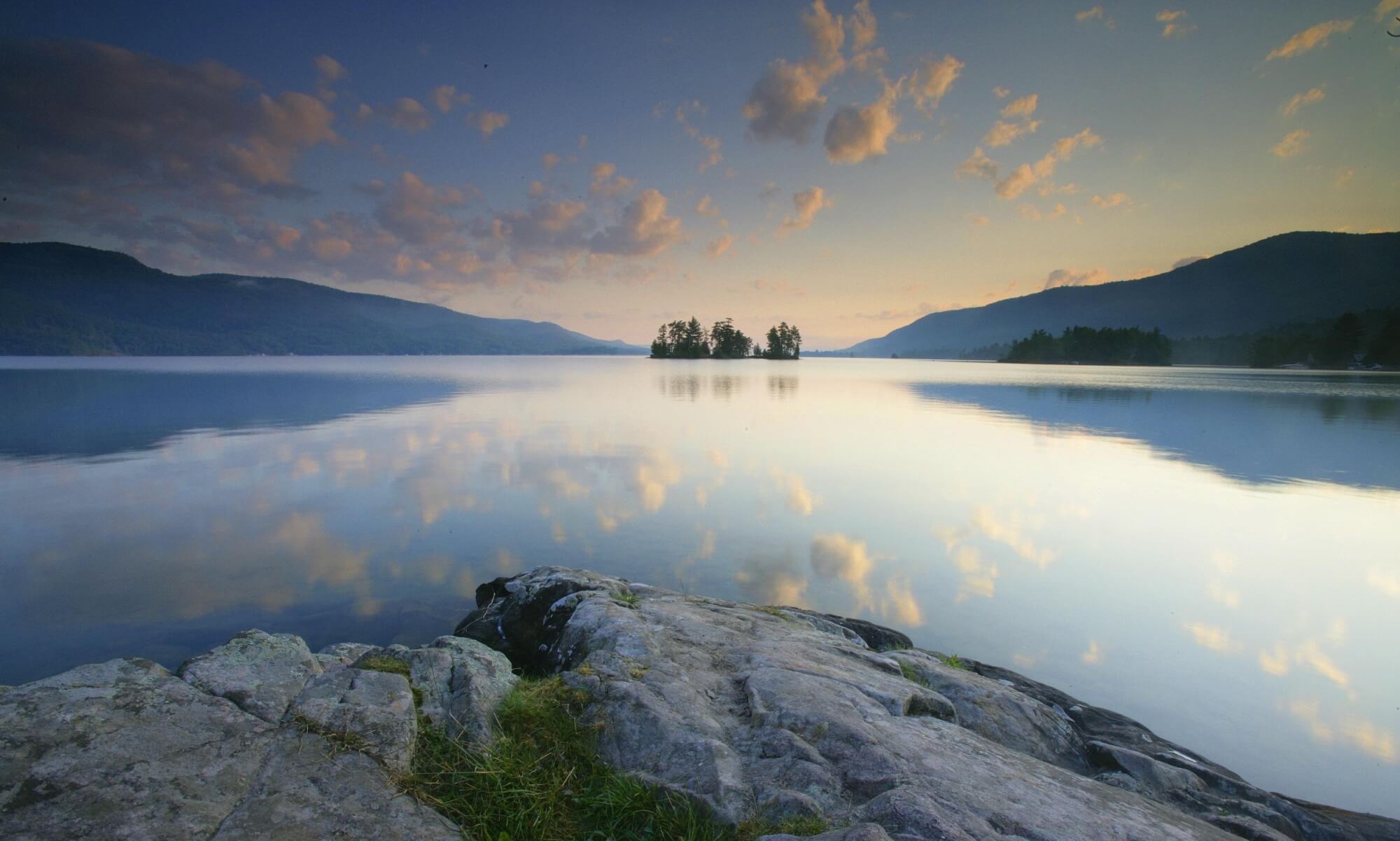
I received this flyer in the mail from the Lake George Land Conservancy announcing their art raffle. For more information you can Helen Barton Benedict, the Conservancy’s Development Manager, at hbartonbenedict@lglc.org or 518-644-9673.
2010 Lake Stewards Report Released

The Lake George Association has released a report for the public with findings from the 2010 Lake Steward program. The Lake George Lake Steward Program is a critical part of protecting the water quality of Lake George and preventing the spread of invasive species between waterbodies by boaters throughout the Lake Champlain Basin and the Northeast. While dozens of different aquatic invasive species reside nearby, only four are currently found in Lake George.
In 2010, Lake Stewards were posted at four launches around Lake George: Norowal Marina, Mossy Point, Hague Town Beach and Rogers Rock. Lake Stewards inspected a total of 2,538 boats at these sites, and educated boaters about the threats of Eurasian watermilfoil, zebra mussels, curly-leaf pondweed, and the Lake’s most recent invader, the Asian clam. Thirty-six samples of Eurasian watermilfoil were removed during the season. Nine samples of curly-leaf pondweed were found, three samples of zebra mussels, and five of water chestnut, an invasive that is not currently found in Lake George.
In addition, the program collects data on the body of water most recently visited prior to Lake George within the past 2 weeks, and whether spread prevention steps were taken prior to launch. In 2010, 65 boaters stated that the body of water they visited prior to Lake George was Lake Champlain, a lake with 49 documented invasive species. Thirty-three boaters had most recently visited the Hudson River, a waterbody with 91 invasives. Ninety-five percent of the boaters reported that they had taken spread prevention measures prior to their launch. Stewards also inspected bait buckets and educated boaters about New York State’s new baitfish and firewood regulations.
The 2010 Lake Steward Program was funded by the Bolton Local Development Corporation, the town of Hague, the town of Ticonderoga, the Lake George Park Commission, the Helen V. Froehlich Foundation, and the NYS Department of State with funds provided under Title 11 of the Environmental Protection Fund. The program was originally conceived by the Invasive Species Task Force of the Lake George Watershed Coalition and is currently coordinated by the LGA.
The entire report can be viewed at: http://www.lakegeorgeassociation.org/documents/2010LakeStewardReport.pdf
Bits of Everything
What is the Berry Pond Tract?
The Adirondack Almanack has a good piece about the Berry Pond Tract and a scheduled hike.
Jimmer Started in New York
I’ve gotten some requests to interview Brigham Young’s Jimmer Fredette because he grew up nearby. He’s a little tough to get an interview with right now but you can learn more about his days locally from the NY Times.
How Big is the Space Station?
The USA Today has an interesting video showing how big the International Space Station is.
Every Oscar Best Picture Ranked
It doesn’t include this week’s winner but here is a fun list from Nerve ranking every Best Picture.
Cave of Forgotten Dreams Trailer
The trailer for Werner Herzog’s upcoming film about the 30,000-year-old cave paintings in Chauvet-Pont-d’Arc — in 3D. Fascinating!
httpv://www.youtube.com/watch?v=oZFP5HfJPTY
West Brook Project Receives Major Gift
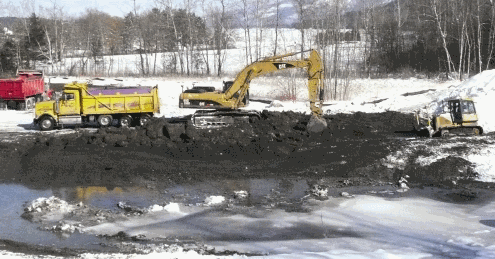 Construction work continues on the south parcel of the West Brook Conservation Initiative project in Lake George. Culverts and rough grading are underway on the site where Charley’s Saloon once stood. The new stormwater treatment complex and environmental park will treat millions of gallons of stormwater each year.
J. Buckley Bryan Jr., recent past president of the Lake George Association, has given a gift of $45,000 to the West Brook Conservation Initiative (WBCI) in Lake George. This gift brings Bryan’s investment in the project to $107,000, making him the second largest individual donor.
Currently under construction on the south parcel of the former Gaslight Village property, WBCI is the largest environmental project in the Lake’s history. The stormwater treatment complex and environmental park will redirect stormwater from Route 9 into settling ponds, marshlands, and a gravel wetland.
“After all our hard work it was gratifying to see physical work begin on the project this past December,” said the LGA’s Buck Bryan. “The demolition of Charley’s Saloon on the south side is complete, and now rough grading is underway,” he said.
“The inlet and outlet culverts have been installed by Kubricky Construction (working for the NYS Department of Transportation), and the land is being graded to the proper elevations for the park’s various components,” said Walt Lender, LGA executive director. “Stormwater from Route 9 will enter the first settling pond via the inlet culvert,” he said. “From there it will travel through shallow marsh wetlands where pollutants in the runoff will be naturally treated through uptake by the plants. Finally, the water will be diverted into either a deep water marsh a gravel wetland, where dense root mats, crushed stones and a microbe rich environment will improve the quality of the water before it returns to West Brook via the outlet culvert.”
Three environmental groups – the Lake George Association (LGA), the Fund for Lake George, and the Lake George Land Conservancy (LGLC) – have worked together to develop the project under the terms of a conservation easement they jointly hold with the village of Lake George and Warren County. Jointly, the groups need to raise an additional $1.56 million to secure ownership of the easement.
The LGLC needs to raise $2.3 million toward the purchase of the 1,436-acre Berry Pond tract, to protect West Brook’s headwaters. The final payment on principal for Berry Pond is due January 17, 2012. “This winter, snowmobilers are already enjoying the wide trails on the Berry Pond tract, that we have approved for use,” said Nancy Williams, director of the Lake George Land Conservancy.
“This project will cleanse millions of gallons of stormwater every year and provide a much needed environmental boost to Lake George, which we all know is our region’s most important environmental as well as economic asset. We salute those who have generously given back to the lake,” said Peter Bauer, executive director of the Fund for Lake George.
The NYS Department of State awarded $152,000 in grants from the Environmental Projection Fund to design the project and $1.2 million for project construction. The West Brook Conservation Initiative partners, including the LGA, the Fund for Lake George, the Lake George Land Conservancy, the village of Lake George, the NYS Department of State and the NYS Department of Transportation are members of the Lake George Watershed Coalition. Formed in 2001 under the direction of the NY Secretary of State, the coalition provides a forum for members to coordinate the complex issues affecting Lake George’s water quality. The nine municipalities and three counties around the Lake, as well as five state agencies and nine nonprofit organizations are members of the coalition.
Bits of Everything
Warren County Lake George Patrols May Go
The Post Star tells us that the Governor’s proposed budget may eliminate Warren County boat patrols on Lake George.
Preview of the Winter Carnival
The Free George previews the annual Lake George winter carnival.
Orion’s Left Shoulder Blowout
A great article on io9 about a nearby star that’s going to go supernova relatively soon.
It’s Cold
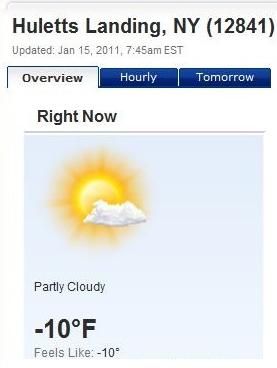
I’ve never considered the Huletts Current a “weather site” but sometimes the weather gets so extreme in Huletts, it makes a good post. Saturday’s morning temperate (at 7:45 am) was -10 degrees.
Sometimes our summer visitors don’t believe how cold it can get in the winter. So here’s proof.
Bits of Everything
High Voltage Cable Inspector: Shock Video
Don’t want to be electrocuted? Make sure you’re not grounded. This is a great video which shows the life of a high voltage cable inspector. You’ll have to click the link because embedding is disabled.
Road Salt Toxic to Adirondacks
Looks like there is more evidence of the harmful environmental effects of road salt, the Adirondack Almanack reports. Once again, true environmental protection has nothing to do with taking people’s private property rights away.
Court Rules Class Action Against Washington County Can Move Forward
The Post Star reports on a potential liability for Washington County.
Have a Good Outdoor Story? Tell the DEC
The Adirondack Almanack reports on a fun contest.
Salmon in the Classroom
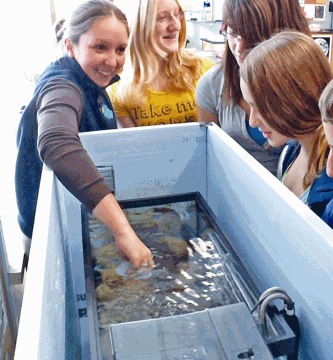
Students at Whitehall High School and Ticonderoga Middle School are raising salmon, through a new environmental education program presented by the Lake George Association (LGA) called “Salmon in the Classroom”.
Kristen Rohne, the LGA’s watershed educator, visited the schools to help set up a 25 gallon tank, chiller and pump, along with testing materials and fish food. Salmon eggs were provided at no cost by the New York State Department of Environmental Conservation.
This winter the students will raise the salmon from eggs to fingerlings. They’ll learn to monitor tank water quality, study stream habitats, and perform stream-monitoring studies to find the most suitable place to release the salmon in the spring. “Our goal is to foster a conservation ethic in the students, while increasing their knowledge of fish lifecycles, water quality, aquatic ecosystems and biodiversity,” said Ms. Rohne. “By working hands-on with the salmon, we believe the students will gain a greater appreciation for water resources and will be inspired to sustain and protect our natural environment,” she said.
This year’s program was funded by a grant the LGA received from the International Paper Foundation. The Lake Champlain-Lake George Regional Planning Board and the Adirondack Resource Conservation and Development Council are partners in the project. Trout Unlimited, a national non-profit organization with more than 400 chapters, designed the Salmon in the Classroom program.
LGA Issues Ice Safety Tips
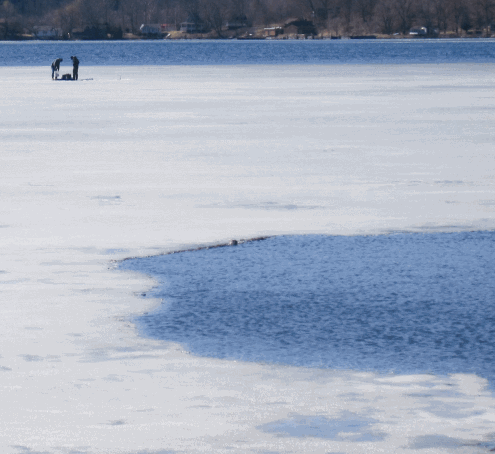
The Lake George Association has published its 2011 Ice Recreation Safety Tips. People who plan to venture out on Lake George ice this winter are urged to follow these tips. Pressure ridges and areas of weak ice present dangerous hazards to those unfamiliar with the Lake.
According to Walt Lender, LGA’s executive director, “Most of the winter emergencies on the Lake are due to complacency. Before heading out, we urge everyone to follow these safety guidelines.”
ICE SAFETY TIPS TO LIVE BY
Always check the ice before you go out on it. Use an ice auger, ice pick, spud bar or a cordless drill to make holes. New, clear, bluish-black ice is stronger than ice that is white or bubble-filled.
Ice does not form uniformly. If ice along the shore is cracked, stay off. Lake George has sub-surface currents that also make the thickness of the ice variable.
Avoid ice that is honeycombed or piled up.
Ice is thinner near running water. Avoid shoreline areas near stream channels or ice eaters on docks.
Stay away from shoals and other underwater hazards as the ice above them is thinner.
Once on the ice, do not congregate in large groups, build a fire, or drive a large vehicle out on the ice.
When snowmobiling at night, don’t “out-drive” your headlight. Give yourself time to spot and avoid open water, pressure ridges and patches of weak ice.
Do not drink. Alcohol increases your chances for hypothermia, impairs your judgment and slows your reaction time.
What to bring:
– Another person. Never go out on the ice alone. Keep a good distance apart as you move about.
– Dress in layers, with a hat and gloves. Wool and fleece are great insulators. Wear a wind- and water-proof outer layer. Top it all off with a Personal Flotation Device.
– A length of rope, a pair of ice picks, or a pair of screwdrivers tied together with a few feet of strong cord. You can use these to pull yourself up and onto the ice.
– Your cell phone in case of emergency.
– A sled (instead of a backpack) if you are bringing along heavy gear. (A sled will help to distribute the weight more evenly across the ice.)
If you fall through:
– Try not to panic.The cold shock that makes you hyperventilate will subside within 1-3 minutes. Get your breathing under control and stay above water. You are more likely to die from drowning than hypothermia.
– Remove any extraneous objects that will weigh you down. (skis, snowmobile helmet, skates, etc.)
– Try to get out from the direction that you came in. Place your hands and arms on the unbroken surface of the ice.
– Begin kicking your feet to get your body horizontal. Then, pull yourself along the ice until you are out of the hole. Be slow and deliberate to conserve your strength and body heat.
– If the ice breaks, move forward and try again.
– Once you are lying on the ice, DO NOT stand up. Roll away from the hole, then crawl following your footsteps back toward shore. Don’t stand until the hole is well behind you. You want to distribute your weight evenly over a wide area to prevent going through again.
– If you can’t pull yourself out within 10 minutes from the time that you went in, cease all attempts. At this point, you need to extend the time period in which someone else could rescue you by conserving body heat. The body loses heat much faster in water than it does in air, so get as much of your body out of the water as possible. Keep your forearms flat and still on the ice. Hopefully, your clothing will freeze to the ice, possibly preventing you from going under, even if you become unconscious. It is possible to survive for up to two hours before succumbing to hypothermia. In other words, if you stay composed and keep above water, you have almost a two-hour window of opportunity to be rescued.
If someone else falls through:
– If you are on the ice, DO NOT run up to the hole.
– If you are on shore, DO NOT run onto the ice.
– Try to keep the victim calm.
– Call 911.
– Look for people nearby who can help.
– Use an item on shore to throw or extend to the victim that will allow you to pull them out of the water. (Rope, ladder, branch, extension cord, skis, jumper cable, etc.) You can also form a human chain with people lying flat on the ice to distribute the weight as evenly as possible.
– Once the victim is safely on shore, they may seem to be in relatively good condition. However, a potentially fatal condition called “after drop” can occur soon afterward. Cold blood that has been pooled in the body’s extremities starts to circulate again as the body warms up. At this point, the body begins to shiver violently in an attempt to raise the temperature again.
– Never rub the victim’s arms, hands, legs or feet, as this could cause or exacerbate the “after drop.”
– Never give the victim alcohol or caffeine. They restrict blood vessels and slow circulation.
– If possible, exchange wet clothes for dry clothes, wrap the victim in a blanket and get the victim out of the elements.
The Lake George Association would also like to remind the public to remember to remove any debris or garbage created out on the Lake ice, as once the ice melts, it will sink into the water.
Cell Phone Tower Update
When I posted the top story for Huletts in 2010 last week, I mentioned that I had spoken to Adirondack Park Agency staff who gave me an update on the two competing cell tower proposals.
Today I received this notice in the mail. While it is dated November 10, 2010, I just received it today.
It is an “Application Completed Notice” for the Independent Towers (Vanderplaat) proposal. It gives a good, technical description of that proposed project.
Top News Story of Huletts: 2010
While I’ve been blogging here on the Huletts Current I’ve gotten in the habit of posting what I consider to be the top news story of Huletts Landing from the past year.
This is entirely my own opinion and while others may disagree, I’ve found it to be a fun exercise which a few have told me they enjoy.
So for 2010, the Huletts Current declares the top story from Huletts Landing to be ………..
The dueling cell phone tower proposals.
In one corner we have the AT&T / New Cingular Wireless proposal (otherwise known as the firehouse proposal), which has now been under review by the Adirondack Park Agency since December 28, 2009.
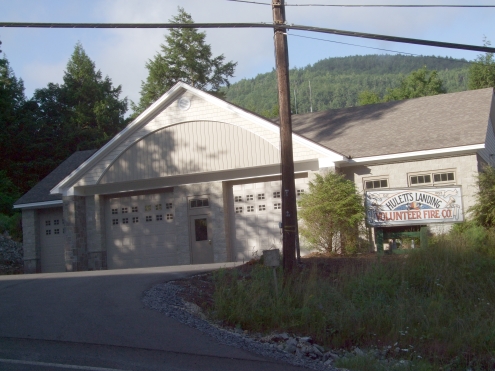
The Huletts Landing Volunteer Fire Company proposed siting a cell tower on its property in late December 2009.
The project is briefly described as follows: “installation of a 100 foot stealth monopole with three flush mounted antenna centered at 84 feet in height with room for two additional carriers to be located below. The monopole will be installed behind the new firehouse with equipment to be located inside the firehouse”.
In the other corner, we have the Independent Towers proposal (otherwise known as the VanderPlaat proposal), which has recently been deemed complete by the APA. The public comment period expired on December 2, 2010. (Which I just became aware of this past week because the APA never sent me a notice.) This is usually the last step before a permit is issued.
This would be for a 90 foot tall monopole which would be located back from the road on a 60 ft by 60 ft wooded area. It also would have room for a total of three carriers.
In a conversation I had with APA staff today, this is the current status of the two proposals. After performing a “balloon test” on both sites, (this is where a balloon is floated at the approximate height of the proposed tower), the conclusive evidence is that the Independent Towers (VanderPlaat) site will have a lower visual impact and have a greater signal range. AT&T is suspending their application until a decision is finalized on the Independent Towers application. At this time, the APA has determined that the Independent Towers application is complete. A final decision is expected by the first week in February.
So no matter where you stand on the issue of a cell phone tower or which proposal you favor, the Huletts Current deems this the biggest story of Huletts Landing from 2010.
Can you hear me now? Maybe in 2011?????
LGPC: Milfoil Update
The Lake George Park Commission released a press release this week, spotlighting the success they have had in fighting the spread of Milfoil. Here are some of the highlights:
A program to manage Eurasian Watermilfoil in Lake George, spearheaded by the Lake George Park Commission, eliminated more than 670,000 plants in 2010. 93% of the 183 sites where nuisance milfoil has ever been found in the Lake were clear of all milfoil at the conclusion of 2010.
The 2010 results are summarized in a report that has been posted to the Commission’s website www.lgpc.state.ny.us. The results indicate that the number of dense beds requiring future management has been steadily reduced in recent years. In 2010, for the first time, more bottom barriers were removed than added indicating that the program has reached a significant level of control.
The Lake George Park Commission has been the lead agency for the management effort for 25 years providing most of the funding from annual user fees paid by local boat and dock owners. Since 2006, State Senator Elizabeth Little has secured annual allocations of State funds from an invasive species program established that year. “It takes a tremendous effort to achieve a result like this,” said Senator Betty Little. “I’m pleased to have been able to play a small role in securing funding. The battle continues, but this level of success has implications beyond Lake George as other communities and organizations will no doubt look here to learn how to successfully fight invasive species that threaten water bodies throughout the state.”
Invasive species are now generally recognized as the most significant threat to the Lake. The Lake’s superior water quality, the signature characteristic for which Lake George is world renown, is in large part a function of complex biological interrelationships. Invasive species have the potential to alter these relationships, the web of life in the Lake, and thereby destroy the Lake’s most attractive qualities.
Bits of Everything
NY Times: Cuomo Wants to Cap Property Taxes
The NY Times has a good analysis of Andrew Cuomo’s tax cap plan with an illustration that shows how school spending is the contributing factor.
How Much is The Trash Plant Worth?
The Post Star looks at how much the Hudson Falls Trash plant could fetch the county.
Man Made Wetlands Coming
The Post Star reports that demolition began at Gaslight Village this week.
Bloomberg Glad He Saddled State with OTB
The NY Post reports that Mayor Bloomberg of NY City is happy he pawned OTB off on the state.