LGA Cleans Out Sediment Basins in Hague


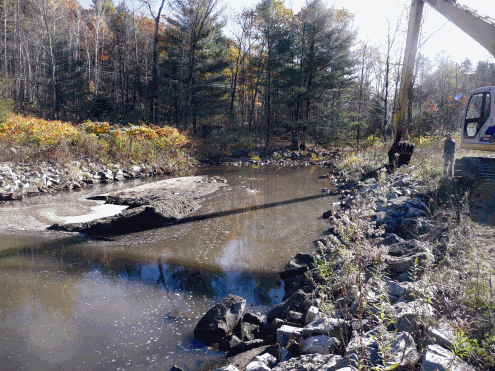
Last week, crews cleaned out the sediment that has built up in a retention basin on Hague Brook. This pond on the upper part of the brook was originally constructed by the LGA in 2006. Over 45 dump trucks full of material was removed from two different retention basins on the brook.

This past week, three sediment basins in Hague were cleaned out: two on Hague Brook, and a third at the mouth of Jenkins Brook. The project was a team effort by the Lake George Association, Warren County Soil and Water Conservation District, and the town of Hague. Over 1100 cubic yards of material was removed from the three sites.

“These basins are instrumental to maintaining high water quality in Lake George,” said LGA executive director Walt Lender. “We began constructing the basins several years ago, and now every one to two years we go in to clean them out. The LGA provides project support and partial funding for the construction projects as well as funding to help maintain the sites,” he added.

Approximately $5,000 of the $8,000 Hague clean-outs has been funded by the LGA, with in-kind management and project oversite by the Warren County Soil & Water Conservation District, and in-kind hauling services provided by the town of Hague. “The town of Hague realizes the importance of maintaining the basins and the health of Lake George. We were happy to contribute to the project,” said Hague Town Supervisor Dan Belden.
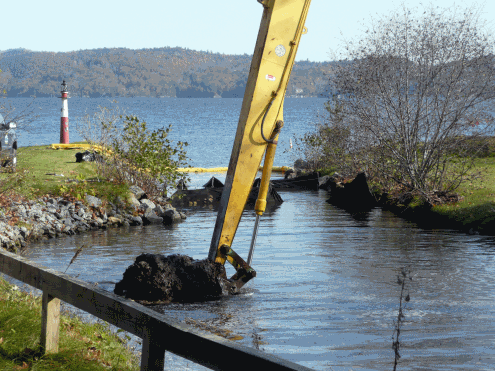

A long-reach excavator removes sediment from a retention basin at the mouth of Jenkins Brook.
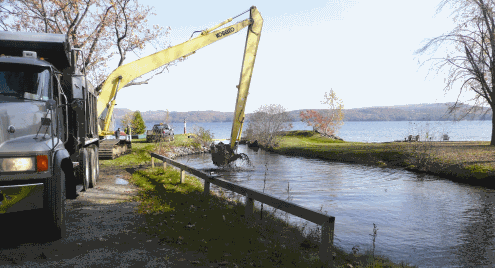
From the upper basin on Hague Brook, crews removed 530 cubic yards of material, or roughly 31 dump trucks full. On the lower basin on Hague Brook, 285 cubic yards of material was removed, equating to roughly 16 dump trucks full. At Jenkins Brook, 345 cubic yards of sediment was removed, roughly 20 dump trucks full. Morrissey Construction provided trucking services and an operator for the long reach excavator, and Services Unlimited also provided trucking services.

Beginning in the early 1990s, an active program of utilizing upland in-stream sediment basins to capture sediment began in Warren County, spearheaded by the Warren County Soil & Water Conservation District (WCSWCD). Old reservoirs were cleaned out and new in-stream sediment basins were created. By slowing stream velocity, basins allow sediment to drop out of suspension and be captured by the basin prior to reaching Lake George.

Lake George Land Conservancy Announces New Position

The Lake George Land Conservancy has announced the hiring of Chad Knisely as the Land Conservancy’s new Land Protection and Stewardship Specialist.
Prior to joining LGLC, Chad worked as acting director for Grand River Partners in Painesville, Ohio, where he managed land protection projects, watershed planning, community outreach and organizational fundraising.

As LGLC’s Land Protection and Stewardship Specialist, Chad is responsible for the creation of a Five-Year Conservation Priority Plan as well as an annual land management strategy for existing protected properties. He also oversees all stewardship needs for LGLC’s seven preserves and nearly 20 miles of hiking trails, as well as manage the organization’s seven conservation easements and lead public hikes and educational programs.

Chad and his wife, Amy, expect to reside in the Glens Falls area with their two young sons.

Funding for this new position has been provided in part by the Land Trust Alliance (LTA) Conservation Partnership Program. The LTA awards were announced in March, when the New York State Department of Environmental Conservation and the LTA joined members of the state Legislature and land trust representatives to announce $1.4 million in Conservation Partnership Program grants. The grants, funded through the State’s Environmental Protection Fund, enable local nonprofit land trusts to increase the pace, improve the quality, and ensure the permanence of voluntary conservation of private lands, resulting in significant environmental and economic benefits for communities across the state.

Preliminary 2011 Lake Stewards Results Released


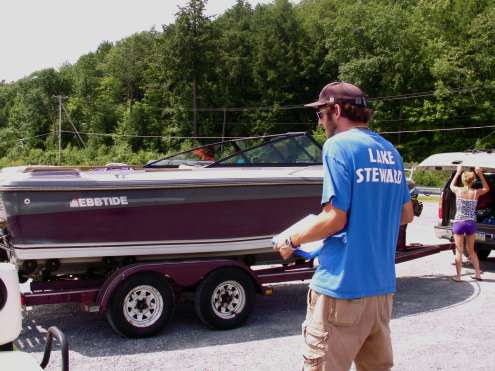
Michael Abrahamson, LGA lake steward, inspects a boat for invasive species at the Dunham’s Bay launch this summer. Dunham’s was a new location for the program this year.

The Lake George Association (LGA) has released preliminary results from the 2011 Lake Steward program. The LGA has managed training, hiring, supervision and reporting for the Lake Steward Program since 2008.

During the summer of 2011, LGA Lake stewards were posted at six different boat launches: Norowal Marina, Mossy Point, Hague Town Beach, Rogers Rock, Dunham’s Bay, and Million Dollar Beach. The stewards inspected 8,584 boats for invasive species, removed suspicious specimens from 52 boats prior to launch, and educated over 19,000 people about the threats of invasive species and how to prevent their spread.

“We had an extremely busy summer,” said Emily DeBolt, LGA director of education and outreach. “From over 8,500 boats inspected, 1,016 were at risk of bringing invasives into Lake George because they had been in a body of water other than Lake George during the past two weeks,” she said. “Right now, Lake George has only four invasive species. Some of our nearby water bodies have dozens.”

Upon launch, suspicious specimens were removed from 52 boats. Of those, 31 of the boats were carrying at least one invasive species. The LGA recovered 22 samples of Eurasian watermilfoil, 9 samples of curly-leaf pondweed, 4 of water chestnut and 2 of zebra mussel.

The stewards also inspected boats returning to the launch after boating on the Lake. Seventy-three of these boats had suspicious samples removed. Of these, 46 boats contained at least one invasive species. The LGA recovered 15 samples of Eurasian watermilfoil, 6 of curly-leaf pondweed, and 2 of water chestnut.

“Our stewards ask the boaters if they have taken preventative steps to guard against the introduction and spread of invasive species. This year, 75 percent of the boats we interacted with said they had,” said Walt Lender, executive director of the LGA. “While this is definitely positive news, and shows that people are becoming increasingly aware of the need to properly clean their boats, we want to see these numbers go even higher in the years to come,” he said.

The program grew significantly from its 2010 level, when 2,538 boats were inspected at four launches. Additional funding provided this year by the Lake Champlain Basin Program and the Lake George Park Commission allowed for more coverage during peak periods and at launches that receive the highest traffic. Additional financial support was provided by the Helen V. Froehlich Foundation. The program was originally conceived by the Invasive Species Task Force of the Lake George Watershed Coalition.

In addition to inspection, lake stewards collected additional data about lake users and invasive species spread. This information sheds light on the pathways of invasive species, and helps to identify target areas for early detection and control. A full report for the public is being prepared and will be ready later this year.

The program is closely coordinated with similar programs. Lake George, Lake Champlain, and the Adirondack Watershed Institute collaborate on training, printed materials, and data collection as members of a regional partnership, the Adirondack Park Invasive Plant Program (APIPP).

LGA Ad Series Continued

The Lake George Association ran a series of ads this summer spotlighting individuals who are contributing to improving the quality of Lake George.

Because things have been quiet lately, I thought I would continue with some of the individuals that were profiled.

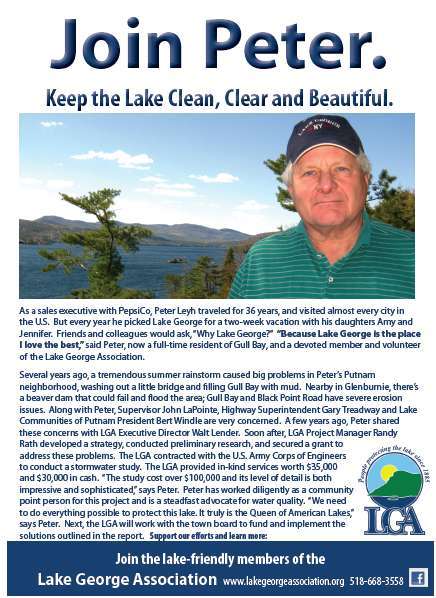
Here is Peter Leyh’s LGA ad. (Click on the picture to follow the link.)

Bits of Everything

Flooding Spawns Aggressive Mosquitoes

The Burlington Free Press has an article on a new round of late mosquitoes.

Town of Whitehall Considering a 10% Tax Increase

The Post Star reports that the town of Whitehall already wants to override the new tax cap.

Milfoil Found in Lake Champlain South Bay

The Adirondack Almanack has a good overview of the problem with Milfoil in South Bay.

Mountain Lion Passed This Way

The Albany Times Union tells us that the DEC was aware of a mountain lion passing through Lake George Village last December.

Glens Falls National Bank Donates $20,000 for West Brook Conservation Initiative

The Lake George Association announced today that Glens Falls National Bank and Trust Company is donating an additional $20,000 to the LGA for the West Brook Conservation Initiative (WBCI) project, located on the former Gaslight Village property. This gift brings Glens Falls National Bank’s total commitment to the project to $25,000.

“In all of our 125 year history, the West Brook Conservation Initiative is the Lake George Association’s largest, most important water quality remediation effort,” said Walt Lender, executive director of the LGA. “This project will treat millions of gallons of stormwater,” he continued, “while also educating thousands of annual Lake George visitors about the importance of water quality. We are so grateful to Glens Falls National for recognizing the importance of this project.”

“Glens Falls National Bank has been a strong partner from the start. We appreciate their increased support,” said Victor Hershaft, LGA president.

Due to the filling of historic wetlands, channeling of the stream, and development in the stream’s watershed, West Brook today is the single largest source of contaminants — pollution, nutrients and sediment — entering the south basin of Lake George. The delta at the mouth of the brook has grown to over 7,000 square meters. To date, $9.4 million has been raised toward the $15 million dollar project.

“Here at Glens Falls National Bank and Trust Company we are well aware of the central role Lake George plays in our region’s economy. We know that protecting the exceptional quality of the lake’s water is essential, and are very excited about this project, as we believe it is key to ensuring a healthy future for the lake and its citizens,” said Tom Hoy, CEO and chairman of Glens Falls National Bank and Trust Company. “And as a result of our donation, we hope other businesses will be able to support this Lake George project as well,” he continued.

Earlier this year, grading and infrastructure for a stormwater treatment complex was completed on the south parcel of the property. This series of sediment ponds and wetlands will naturally slow stormwater generated from the Route 9 corridor and adjoining properties, capture sediment, and filter pollutants. Wetland plants will be installed next year. Project engineers estimate that 90% of the sediment will be successfully treated and over one-half of the nutrients will be removed.

Conceptual designs for an interactive environmental education park and festival space on the property are underway, and were approved earlier this fall by the Warren County Board of Supervisors. Public input for the designs was gathered over the summer, and a public review of the concepts will occur later this fall.

Significant state and federal funding has been acquired to complete the construction of the project, but monies still need to be raised from private individuals and corporations to pay for the conservation easement on the land. In addition to a $2.1 million loan on the Gaslight Village purchase by the LGA and the FUND for Lake George, the Lake George Land Conservancy is carrying a $2.7 million loan on the 1,400-acre Berry Pond tract, which protects the upland watershed for West Brook.

Bits of Everything

Whitehall Times: Finch and Chubb and Marina to Close

The Whitehall Times reports that the Finch and Chubb restaurant is closing. But that’s OK; folks can always go to the Silver Diner…oh…wait…

Lake George Village Underwater

The Lake George Mirror has some amazing pictures of Irene damage at the southern end of the lake. (Page loads a bit slow.)

Fair Haven Hit By Skyline Closing

Whitehall isn’t the only local town being hit hard. Nearby Fair Haven Vermont is losing a major employer according to Vermont Today.

LGA Cleans Up After Irene


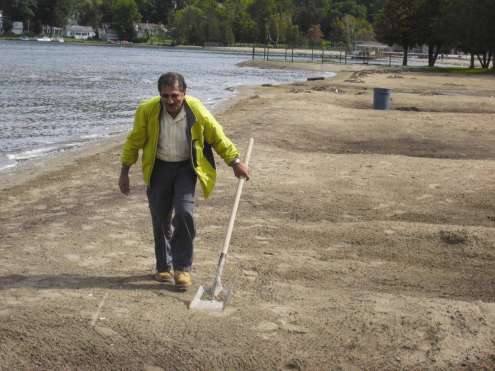
LGA Volunteer and board member Salim Amersi works as part of a LGA beach clean-up effort after Tropical Storm Irene.

Tropical Storm Irene left large amounts of debris on the beaches at the southern end of Lake George, and due to the wide-spread damage caused by the storm, officials weren’t able to attend to it immediately. On Saturday, September 17th, volunteers from the Lake George Association stepped in to remove the debris and rake up the beaches.

“Tropical Storm Irene created a real mess along Million Dollar and Dog Beach, and I saw that it wasn’t getting cleaned up very quickly, so the LGA got on it,” said Mike Grasso, an LGA volunteer and board member. “There were pieces of asphalt in the Lake near the West Brook Inlet, lots of blue Styrofoam, empty water bottles, and lots of other manmade and natural debris everywhere. This past Saturday LGA volunteers raked it all up before it could float back out into the Lake,” he said.

“The area is once again pleasant for walking and in good shape for our shoulder season tourists,” said Walt Lender, LGA executive director. “But its’ not just about aesthetics, this was a water quality problem too. We wanted to make sure to pick up the plastic, especially the Styrofoam, before it returned to the Lake,” he said.

Styrofoam is a particularly bad product for the environment because it does not biodegrade, and is not easily recycled. It crumbles into fragments that have no expiration date, and persists indefinitely as litter, breaking up into pieces that choke and clog animal digestive systems in waterways.

Summer Sets

As of 5:05 A.M. EDT on Thursday, September 22nd, the FALL EQUINOX began. This means summer has officially ended.

There are many ways to look at this. However going with the glass is half full approach, autumn now begins with its vibrant colors and cool nights!

And it’s also one day closer to next summer!

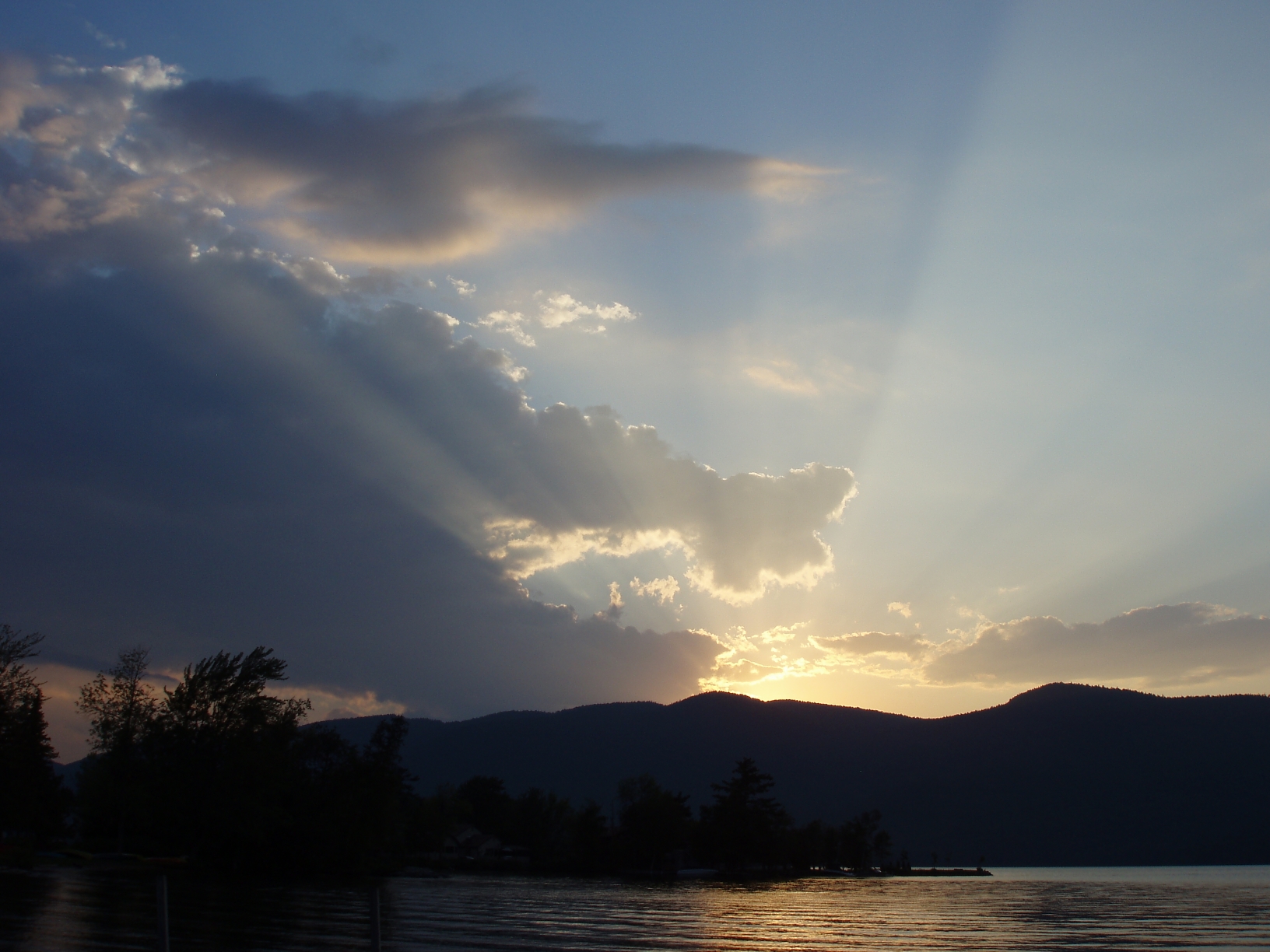
Thanks to Kathy Francis for submitting the picture of the sunset above. (Click to see full scale.)

Warren County Passes Invasive Species Law


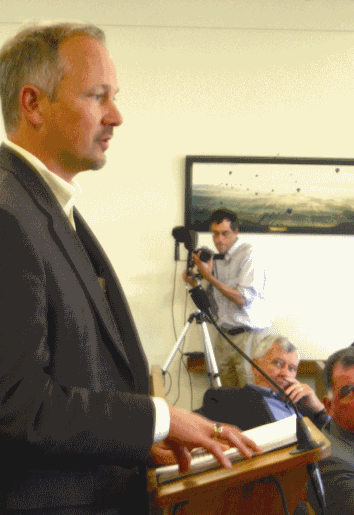
Walt Lender, executive director of the LGA, comments at a public hearing before the Warren County Board of Supervisors, about the new invasive species transport law they recently passed. The LGA provided information to the supervisors which led to the drafting of the new law. The county law is based on a law that is still pending at the state level.

The Warren County Board of Supervisors voted almost unanimously to pass an invasive species transport law on Friday September 16th after a public hearing about the law.

“The LGA has been working for weeks with the supervisors to help draft this law, which is based on a law that is still pending at the state level,” said Lake George Association Executive Director Walt Lender. “This groundbreaking law will help us tremendously in our efforts to fight invasive species on the Lake. The LGA plans to be instrumental in teaching people about the law, and in helping area business owners explain the law to visitors next summer,” he said.

The law will make the introduction and transport of aquatic invasive species into Warren County waterbodies illegal. It is the first county law of its kind to pass in New York State. “Several towns have passed similar laws, including Lake Pleasant and the village of Lake Placid, but county and statewide efforts are really needed, otherwise controlling the spread of invasive species is too piecemeal,” said Emily DeBolt, LGA director of education.

“With this law in place more people will pay closer attention to the issue of invasives on Lake George, and we hope the leadership and initiative that the supervisors have shown in passing this ground-breaking law will soon be duplicated in other counties and at the state level,” Lender said. “Our lake stewards and staff have spent hours actively fighting the Asian clam this summer — erecting signage, producing and distributing brochures, securing mats with sandbags, and most recently, surveying the lake for additional sites. It makes little sense for the LGA, and for other organizations, to spend tens of thousands of dollars removing invasives from Lake George when people can legally re-introduce them,” he continued.

“The LGA is particularly grateful to the Warren County Board of Supervisors and its legislative committee chaired by Supervisor Bentley. They clearly see how important this action is for the Lake,” Lender said.

For decades, the LGA has been educating people about invasive species and the threats they pose to Lake George, both environmentally and economically. LGA Lake Stewards inspect boats at area launches, removing specimens of invasives prior to launch, and educating boaters. “Since starting the Lake Steward program in 2008, we have seen over 16,000 boats and have removed 270 specimens of invasive species,” said Emily DeBolt, LGA director of education. “The vast majority of boaters want to do the right thing, and certainly don’t intend the Lake any harm. Laws like this will help us tremendously in communicating the seriousness of the threat,” she said.

One of the reasons a law like this is so important is because Lake George is surrounded by water bodies that have invasive species, and LGA’s lake steward data shows how frequently boaters come to Lake George from these infested waters. The Great Lakes have 184 invasive species. The St. Lawrence River has 87. Lake Champlain has 49. The Hudson River has 91. Lake George has only the four: the Asian clam, Eurasian watermilfoil, Zebra mussel, and curly-leaf pondweed.

LGA Testifies at State Assembly Hearing

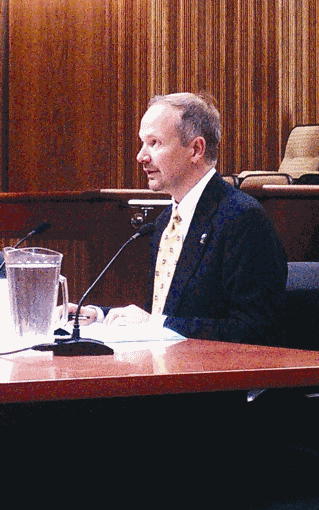
Walt Lender, executive director of the Lake George Association, testifies at a New York State Assembly hearing on invasive species on Tuesday, September 13th. Mr. Lender spoke out in support of laws to prohibit and regulate the transport and sale of invasive species, both terrestrial and aquatic.

Lake George Association Executive Director Walt Lender testified for a state assembly hearing on invasive species on Tuesday. The hearing reviewed how aquatic and terrestrial invasive species are introduced in New York State, methods to combat the species already present, and the effectiveness of state funding, including Environmental Protection Fund monies.

While environmental groups across the nation spend millions trying to combat invasive species from destroying our natural habitats, many of these same species, including the Asian clam, continue to be sold and transported legally in the state, and the nation.

‘‘We request and strongly support the passage of laws to prohibit and regulate the transport and sale of invasive species in New York State,’’ concluded Lender in his testimony. Lender described the effort and expense of the Asian clam eradication project in Lake George, which topped $500,000 in only one year. He also explained the ongoing expense of invasive species management on the Lake, including $3 million spent since 1995 by several groups to manage Eurasian watermilfoil, $50,000 spent annually on the LGA’s Lake Steward program, and thousands more spent each year on education and outreach efforts. Lender stated, ‘‘If laws were in place prohibiting the transport and sale of invasives, some of this spending might have been unnecessary.’’

Lender also requested that additional funds be set aside for invasive species management in Lake George and statewide. ‘‘In the case of the Asian clam fight on Lake George for example, local governments and environmental groups contributed over $400,000, in addition to state funding. But invasive species are not just a Lake George issue. They are a statewide and nationwide threat,’’ Lender added.

Other testimonies were provided by Michael Goehle, US Fish and Wildlife Service; Chris Amato, assistant commissioner of the NYS Department of Environmental Conservation; Troy Weldy, director of ecological management for The Nature Conservancy; Terry Martino, Adirondack Park Agency, and Judy Littrell, NYS Association of Conservation Districts, among others.

The hearing was sponsored by NYS Assemblyman Robert Sweeney, chair of the Assembly Standing Committee on Environmental Conservation. Mr. Lender was invited to testify by Assemblywoman Teresa Sayward. The New York State Invasive Species Council was created in 2008 to coordinate among multiple state entities and partners in addressing the environmental and economic threats of invasive species. The council prepared a report to the legislature and the governor to recommend lists of prohibited, regulated, unregulated species plus a procedure for the review of unlisted non-native species. ‘‘Two pieces of this suggested legislation have stalled,’’ said LGA Education Director Emily DeBolt. ‘‘We are hopeful that this hearing will help get things moving forward,’’ she added.

Hurricane Update: Thursday Afternoon

Here is what I can report regarding Thursday (9/1) in Huletts.

Phone service has been restored to many homes and the cleanup is well underway.

The Labor Day weekend weather looks good.

All-in-all Huletts was very lucky. Vermont still has a long way to go.

Message from National Grid

The effect of Irene is still being felt across the communities served by National Grid. At its peak, nearly 850,000 New England customers and more than 150,000 New York customers were without power. We have now restored power to approximately 80% of our New England customers and more than 90% of our New York customers. Crews continue to work around the clock to restore power.

Estimated restoration times are available by calling us at 1-800-465-1212 in New England and 1-800-867-5222 in New York.

We recognize the inconvenience and dramatic impact being without power has on our customers and we thank you for your patience and understanding.

We want to remind customers to stay safe as the restoration and clean up continues. Be extremely cautious when clearing debris near power lines and call us if you see any downed wires.