
The LGLC is the Lake George Land Conservancy.
News & Opinion About Huletts Landing, N.Y.
The LGLC is the Lake George Land Conservancy.
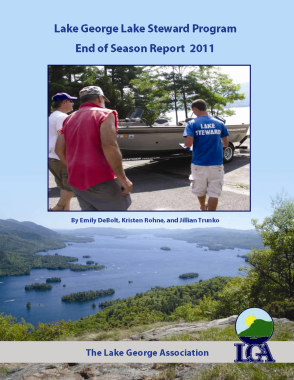
The Lake George Association has released a free report to the public with findings from the 2011 Lake Steward program.
Since 2006, lake stewards have inspected boats at high traffic launches around the Lake and have educated boaters about invasive species spread prevention.
Over the 2011 season, the Lake George lake stewards interacted with 8,593 boats:
· Within two weeks of their launch in Lake George, boaters had visited 193 unique waterbodies located in 15 different states.
· Other than Lake George itself, the next most frequently visited waterbody was the Hudson River, a waterbody with 91 different invasive species; 100 boats inspected had been in the Hudson within two weeks prior to launch in Lake George.
· Lake stewards collected 171 aquatic organism samples from 125 boats and trailers, and identified 87 samples to be invasive species.
· Four different species were found: Eurasian watermilfoil, curly-leaf pondweed, water chestnut and zebra mussels.
· 75% of boaters reported taking spread prevention methods before launching in the Lake.
Correction to my Interview with Walt Lender, LGA Executive Director
In my interview with Mr. Lender of the Lake George Association, I asked the following question:
“The LGA has been in the forefront of removing large delta’s that have formed in the lake. The FUND for Lake George, your partner in the West Brook Conservation Initiative, is opposed to these efforts and says it may sue to stop them. What should people make of all of this?”
As someone who has had my words misstated in public at times in the past, I am keenly aware of the importance of getting my facts correct and I make every attempt to accurately convey the positions of those whom I base my questions and assumptions on.
The source for my original question was this Post Star article entitled: “Lake George groups clash over proposed dredging of brooks’ deltas.” The article details the disagreement between those who favor and those who oppose the removal of deltas in Lake George.
The quote from this article that formed the assumption of my question was this particular line: “Backers of the $250,000 Finkle Brook project expect the Fund to file a lawsuit if DEC signs off on the project.”
I was incorrect to state that the FUND for Lake George has said that it may sue. As you can see, the quote from the Post Star that I based my assumption on was from; “Backers of the … project” who were unnamed. As such, my question as originally stated was in error.
I can point out that when the Foster Brook delta removal project in Huletts Landing was approved by the NYSDEC, there was no legal action taken by the Fund or the Waterkeeper.
I am correcting my original post and apologize for the erroneous statement contained in my original question.
 A demonstration section of porous pavement in front of the LGA offices in Lake George show the effective performance of the material during the winter months; ice and snow does not build up on the surface of the material to the degree that it does on the traditional gravel surface surrounding the porous section.
Beach Road at the south end of Lake George will be re-built this spring with an unconventional pavement: porous asphalt. Upon completion, Beach Road will become the first heavily traveled roadway in New York State (and one of the only roads in the Northeast) to be paved with porous asphalt.
“This is one of the most important lake saving projects ever for Lake George,” said Walt Lender, LGA executive director, “and a first of its kind for New York State,” he said. “The LGA recognizes both Warren County Superintendent of Public Works Jeff Tennyson, the state Department of Transportation, and the Federal Highway Administration for taking the bold steps to move forward on this revolutionary project, one we believe will get national recognition, and will set a precedent for many like it to follow in other lakeside communities,” said Lender.
The engineering firm of Barton & Loguidice (B&L) is designing the project, which has been funded with state, federal and county monies. Construction will begin in May of this year with completion in the fall of 2013. The porous pavement will be installed between Canada Street and Fort George Road.
Current plans for the timing of the project are:
– Late Feb 2012: Warren County releasing bid packages to contractors
– Early May 2012: Contract awarded
– June 2012: Groundbreaking for the project
– July 2012 – Nov. 2013: Construction
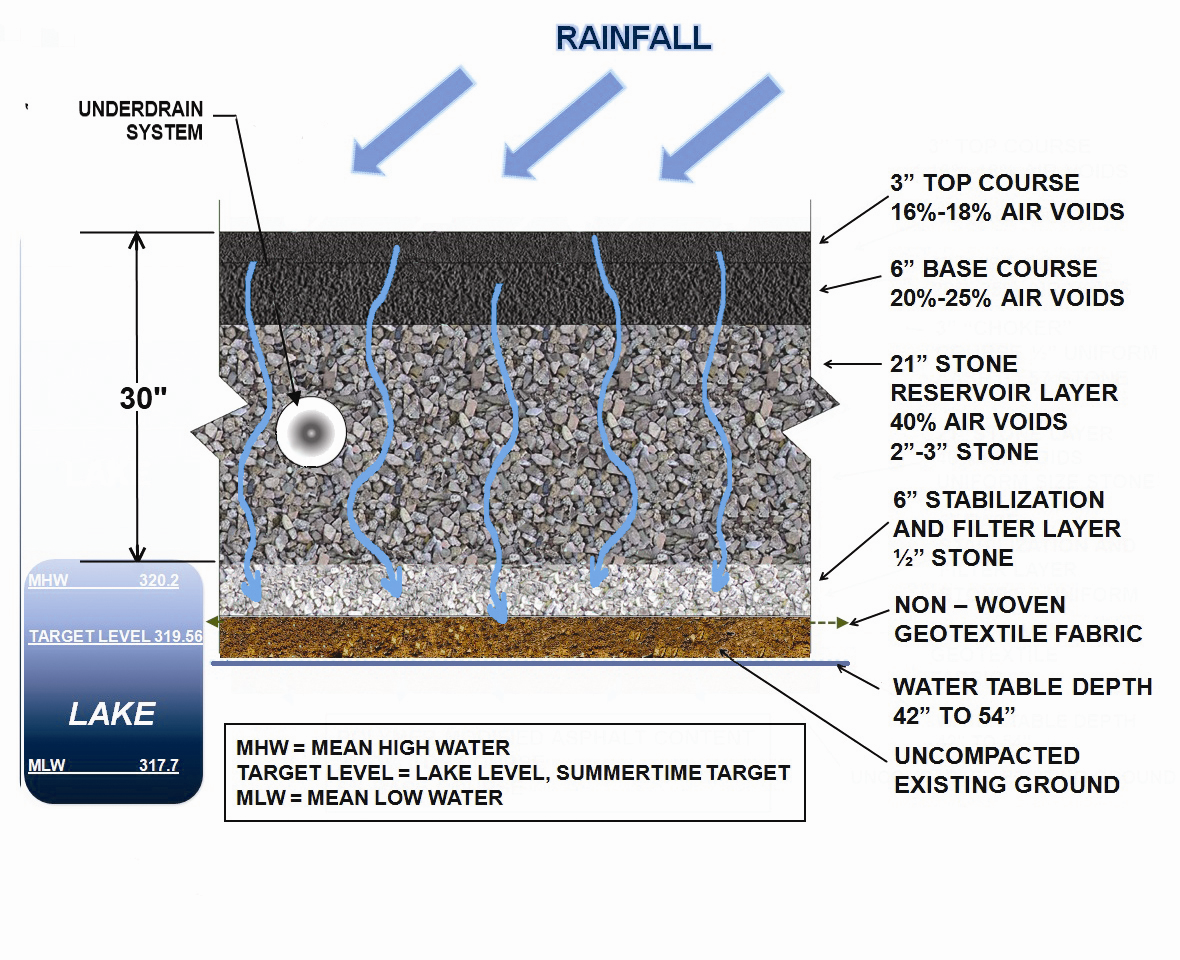
Porous asphalt is mixed with stone that is coarser than that used in conventional pavement. Without sand and finer particles in the mix, air takes up the spaces in the porous asphalt once occupied by the smaller particles. These air, or void, spaces account for approximately 15-20% of the volume in porous asphalt pavements compared to approximately 2% for conventional non-porous pavement mixes. During a storm event, water passes through the air voids in the asphalt down to an underlying stone reservoir layer comprised of clean, washed, angular shaped stone, uniformly sized in the 2” to 3” range. Stormwater is temporarily stored in this 12- to-30-inch-thick reservoir layer as it is absorbed into the underlying soils below. It is in the asphalt, stone, and underlying soil layers that trap and break down the contaminants carried by the water.
Within the past 10 years new polymers and additive fibers have been developed that are much more effective in binding the larger stone in the asphalt mix. These polymers and additive fibers have improved the durability of permeable asphalt in recent years.
One of the greatest benefits of porous pavement is the need for less road salt in the winter. Reductions in salt usage on porous pavement have shown to be 50% or greater in many communities with the greatest reductions in use coming between storms since the need for salt to control black ice is significantly reduced.
Salts (or chlorides) are a soluble (dissolved in water) contaminant and cannot be removed by the porous pavement structure, ponds, wetlands, or vegetated swales. It is by reduction of their use that will be the benefit to the lake. Other pollutants such as zinc, lead, copper, chemical oxygen demand, cadmium, and total phosphorus have shown removal rates of 40% to 95% in porous asphalt applications (source: NYSDEC).
(Click on images to see full scale.)
Recently, I had the opportunity to interview C. Walter Lender, the Executive Director of the Lake George Association.
“Walt” as he is known by many on Lake George, guides the day-to-day activities of the Lake George Association. Below is my interview with him.
The Lake George Association is known as the premier organization working to protect Lake George. Could you tell our readers a little bit about yourself, how you became involved with the LGA and what your role as Executive Director is?
I have spent my career in the not-for-profit world, and I have a background in fund-raising and administration. I have also lived on Lake George all my life and have been involved in environmental issues and land use planning. I have always been an advocate for protecting the Lake from years back when I would give neighbors a hard time about feeding the ducks or make a pointed comment to a boater flipping a cigarette butt into the Lake. When the LGA executive director position opened in 2004, I could think of no better opportunity than the chance to make a career out of protecting the place I love.
As the LGA’s executive director I lead a staff of professionals who are tasked with various roles in fulfilling the LGA’s mission. I do a fair amount of fund-raising and a good deal of administration and management. We have a very experienced group of staff members who manage our projects, provide our educational and outreach programs and services, develop our member and donor base, and get the word out about what we do. My role is to make sure that we are fulfilling our mission to the best of our ability, and that we have the funds we need to do that effectively and efficiently.
What are some of your favorite activities on Lake George?
I have always loved swimming in Lake George. I first came here as an infant and then every summer thereafter until moving here to Black Point in Ticonderoga year-round at age nine. I was always bewildered when swimming in other water bodies as to why I sometimes could not see the bottom, even when only waist deep. Lake George has always been the gold standard for water quality for me. I also love taking friends and family out on the Lake on our boat in the summer to enjoy the scenic beauty and tell stories about its history. Inevitably they fall in love as I have done. Now that my wife and I are raising a family here on the Lake, we enjoy taking our six little ones (yes, six) out to one of the islands in the Waltonian group near Hague for picnics. We haven’t attempted overnight camping there yet, but I’m sure we’ll try that out as they get a bit older. I have sailed on Lake George, canoed and kayaked, fished a bit, and even tried SCUBA, but I think I most enjoy just sitting on the shore at the end of the day in the summer watching our kids take one last swim before the sun drops behind Rogers Rock.
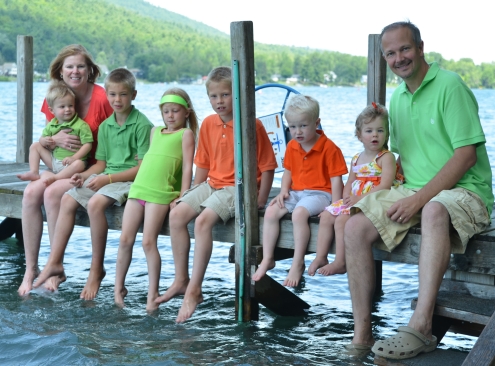
The Lender family relaxing on Lake George.
The Lake George Association is involved in a very big reclamation project, which I note is quite unique, in Lake George Village. Could you give some background on this project and explain where the project presently stands?
Much of what the LGA is doing right now is unique. The LGA is often the leader in finding ways to better protect the Lake’s water quality. If you are referring to the West Brook Conservation Initiative on the old Gaslight Village property in Lake George, it is perhaps the first of its kind in the Northeast. What makes it unique is the public-private partnership involved in making the project happen. Rarely do you see several different not-for-profit organizations and municipal governments working together on something of this scale. The project will divert and treat millions of gallons of polluted stormwater draining off one of the most developed areas in the Lake George watershed. The earthwork, contours, and infrastructure for the stormwater treatment complex on the south portion of the site are already in place, and we should see wetland plants installed in the spring. This area was historically a massive wetland at the mouth of West Brook at the southernmost tip of the Lake which naturally filtered the stream before it entered the Lake. One of the most fulfilling aspects of the project is that it is restoring a wetland area that was filled in generations ago when people did not understand how critical it was in protecting the Lake. Now, with an engineered design, it can go back to its role in protecting Lake George water from sediment, harmful nutrients, and other pollutants.
So if everything falls into place, when do you hope it will be completed and what should the public expect?
The wetland restoration aspect of the project should be completed in the summer of 2012 when it will begin to manage stormwater. But one of the best parts of this project is the fact that this whole, once-blighted property, where Gaslight Village used to be, will become a beautiful public park. The LGA secured a $2.5 million dollar Federal Transportation Enhancement Program grant to build a park on the property as an overlay to the stormwater management function. So while stormwater will be filtered and cleaned, the public will be able to walk on trails and boardwalks throughout the wetland areas, and the municipalities will have functional open space to hold special events. This larger project will take a bit longer. This winter, in response to much public input, the consultants will be finishing up the design and engineering documents for the park elements and it should go out to bid later this year for construction in 2013. I’m sure everyone will be pleased with the result. It will be a great asset for the greater Lake George community.
The LGA has been in the forefront of removing large delta’s that have formed in the lake. The FUND for Lake George, your partner in the West Brook Conservation Initiative, has a different point of view on delta removals. What should people make of all of this?
Yes, the debate over delta removal has certainly heated up recently. I agree with some of the points that the Fund and Waterkeeper programs have raised, and we have addressed their concerns. Many more groups, municipalities, and individuals support removing the deltas than oppose it. We have performed hundreds of thousands of dollars worth of remediation, retrofitting, and streambank stabilization in the watersheds of these streams. More areas of concern are also bound to come up in time. But we feel that it is time to remove certain deltas. Other streams might need more work before their deltas are removed. None of us wants to remove a delta and have it fill right back in. That would be impractical and not cost effective. We want to see these deltas removed in a way that we can be sure no harm is done to the Lake.
I know everyone loves Lake George, but for many Lake George is a second home and they’re not here all the time. How do suggest that regular “folks” who are not always here, help support your efforts?
Membership is key to our success. Our funding stream depends on dollars raised through Member dues. We need everyone who enjoys Lake George to have some part in protecting it for the next generations. That’s our collective responsibility. Those who came before us gave us a gift, and we need to pay it forward. The LGA was formed by its original members over 126 years ago largely because those who were not able to be here on the ground taking action and being vigilant relied on those few who were able to be present at the Lake. More folks are here year round than was the case in 1885, but it still takes a certain ability to focus on the issues and take action when we can. Not everyone can do that with today’s busy schedules, but the LGA is tasked with that responsibility. It’s our mission. We have a professional staff of year-round employees supplemented by summer Lake Stewards all of whom work to protect the Lake. Our greatest limitation is our funding. We need private and public funds to accomplish all the projects that we undertake and provide all the programs that we have developed. People can stay in touch with the LGA all year long and from anywhere in the world through our website, facebook, and e-news. Subscribe here: www.lakegeorgeassociation.org
While the summer is still a long way away, a lot of things happen here in the winter. Can you tell our readers how the LGA works to protect the lake during the cold winter months?
While there is no “down time” in any effort to protect such a precious resource as Lake George, the winter months see us shift gears from programs that take place outside on the Lake or along its shores to education programs in the classrooms, pre-development work (engineering, planning, and design) on upcoming stormwater projects, reporting on the past season’s activities, grant-writing and fund-raising. Your readers might be interested in the “Salmon in the Classroom” program that we are bringing to the Ticonderoga and Whitehall Central Schools. Perhaps they want to see the recently published results of the 2011 Lake Steward program. They may even want to hear about our recent work with the Lake George Elementary School. Our facebook page and website have the latest news.
Finally, I would be remiss if I didn’t ask how our readers can do something to help you?
I gather that most if not all of your readers are Lake George people, whether they live on or near the Lake or just visit. I’m sure that they love the Lake and want to protect it from all the threats that are out there. That’s what the LGA does, and we can’t do it without the help of our members. The LGA is the only membership organization protecting the Lake. Our members have been actively doing that since 1885. That’s a great legacy and one that everyone on the Lake should want to be part of. Your readers can join us through our website at www.lakegeorgeassociation.org.
What role do volunteers play in your efforts?
We have formal and informal volunteer opportunities here at the LGA. We are in the ninth year of our “citizen science” lake monitoring program through which volunteers commit to take water samples and collect water quality data. Our data is combined with data from other New York State lakes as part of the Citizens Statewide Lake Assessment Program (CSLAP). We have limited volunteer slots open for that program, but it is one way we involve volunteers. We also organize stream clean-up events, and trash removal after Log Bay Day or on the ice (when there is any.) We have involved volunteers on mailing projects and other office work, as well. And we always need volunteers for fund-raising events and activities. Our governing Board of Directors are also volunteers. Perhaps one of the best ways for people to volunteer is on one of our committees.
Thanks Walt for your time and for all you do for the “Queen of America’s Lakes.”
George, I’m very pleased to have this opportunity. I enjoy reading your blog. It’s very informative and well done. Keep up the great work!
Lake George Road Getting Porous Pavement
For a long time I’ve been a proponent of having technical advances play a part in environmental protection. The Adirondack Almanack has an interesting piece on porous pavement.
Lake George Park Commission Committee Wants All Boats Washed
The Lake George Park Commission is toying with the idea of washing boats before they go in the lake, so says the Post Star.
Whitehall Man Charged in Burglaries
The Post Star reports on a Whitehall man serving time in Vermont being charged with break ins from Washington County.
Winter Raptor Fest Celebrates Endangered Birds of Prey
An interesting symposium on at-risk winter birds.
Courtesy of the Lake George Association
httpv://www.youtube.com/watch?v=T_N5sXgbDxE&list=UUM-C-6iAH-MdI6g8xPM2mVA&index=1&feature=plcp
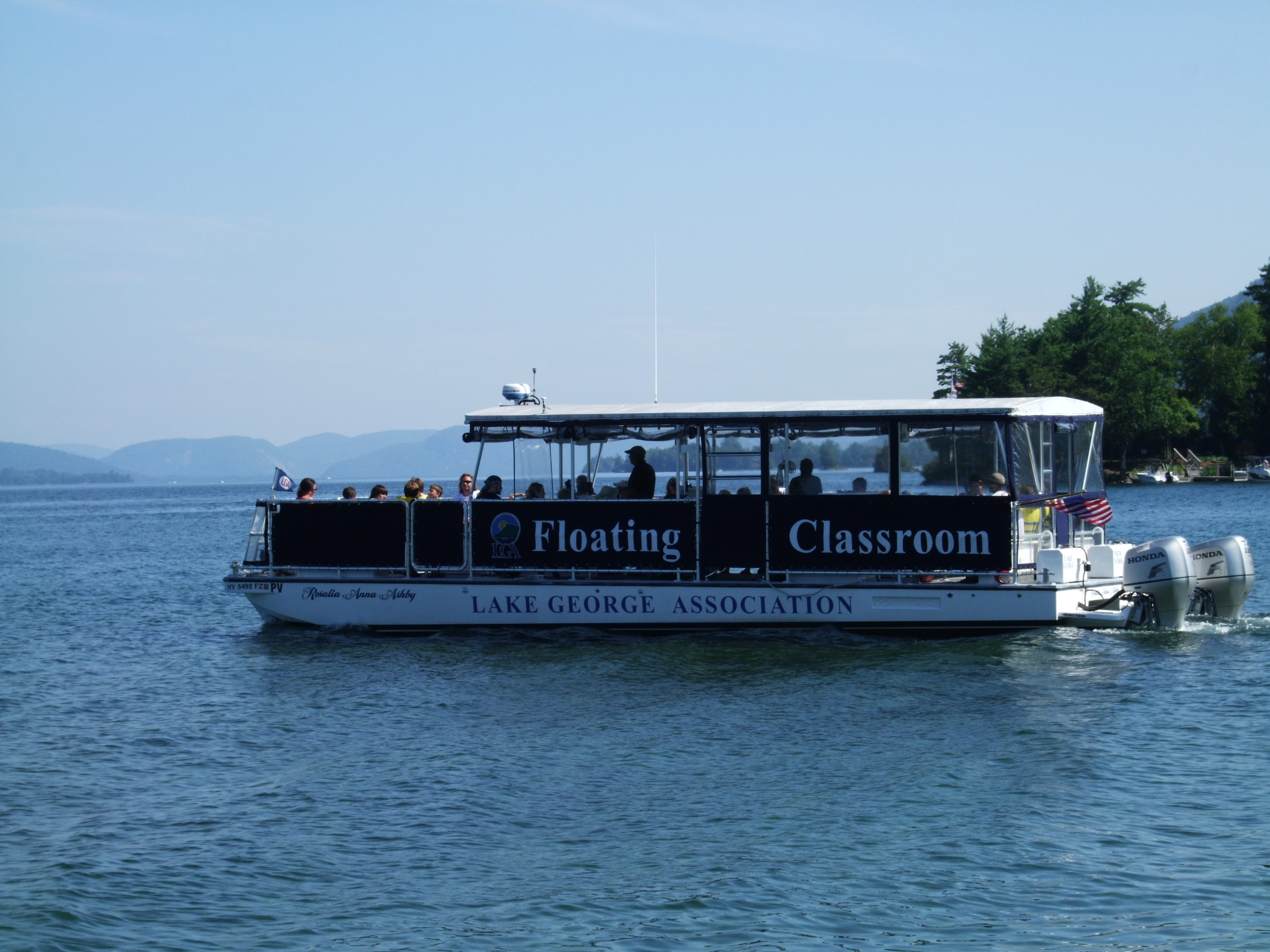
Over 30 people, including many children, enjoyed having the Lake George Association’s Floating classroom stop in Huletts in 2011.
I’m pleased to announce that the Lake George Association’s Floating Classroom, will return to Huletts on Friday, July 20th at 1:00 pm, courtesy of the Friends of Historic Huletts Landing who is sponsoring this event.
A donation will be required to help defray the cost but I’ll have more specifics as the date draws closer.
So if you missed the excursion last summer, please plan on attending the trip in 2012!
(Click on image to see full-scale.)

A rabid goat has been confirmed north of Huletts Landing in Essex County.
In addition to this, there have been 4 rabies positive raccoon’s, multiple skunks, and 1 fox in Washington County within the past year.
Rabies is spread through the saliva or brain tissue of an infected animal. In many instances, it comes through a bite. If treatment is initiated promptly following a rabies exposure, rabies can be prevented. If a rabies exposure is not treated and a person develops clinical signs of rabies, the disease almost always results in death.
In animals, many times the animal gets aggressive. In other instances the animal grows lethargic. Seeing a nocturnal animal in the daytime can be a sign that that animal has rabies.
Exposure to rabies may be minimized by:
* having all pets vaccinated and keeping them up-to-date on their vaccinations
* avoiding contact with all wild animals, especially those acting abnormally (such as being out during the day when they are typically nighttime animals)
To control the spread of rabies in wild animals, such as raccoons, the New York State Department of Health oversees projects to distribute a special bait containing rabies vaccine. Baits are placed in areas frequented by raccoons in order to immunize them against rabies.
Please be careful, rabies has been found in numerous animals nearby.
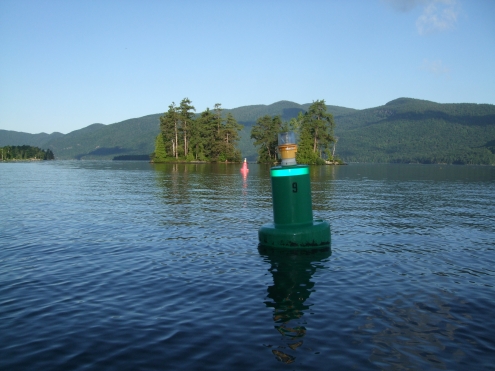
The water off of Huletts Landing was measured to be some of the clearest water in the lake in 2011.
Lake George received the best reading on a measurement for clarity among 98 New York lakes in 2011, the Lake George Association announced today.
“If you want clear water in New York State, Gull Bay on Lake George is the place to be!” said Nancy Mueller, the manager of the NYS Federation of Lake Associations, Inc., the organization sponsoring New York’s Citizens Statewide Lake Assessment Program (CSLAP), in conjunction with the NYS Department of Environmental Conservation. On Lake George, the program has been coordinated by the Lake George Association for the past eight years.
Peter Leyh, an LGA member, was one of several 2011 volunteers to participate in CSLAP. Peter sampled water near Gull Bay on the north end of the lake, and sank a measuring disk for clarity, called a Secchi disk, into the lake. He was able to see the disk in the water at a depth of 11.3 meters on July 5, and he recorded a reading of 11.35 meters on August 22. Both times Peter was able to see the Secchi disk at a depth a little over 37 feet. On August 7, LGA CSLAP volunteers Jack and Cathy LaBombard, who were testing the water near Huletts Landing, recording a reading of 11.24 meters. No other lake participating in the CSLAP program this year could match these readings.
“The rainy, stormy weather had most of the readings across the state down this year– so it was nice to have a few double digit readings. They were hard to come by,” said Mueller.
Readings taken by participants on the LGA’s Floating Classroom showed similar results. “We had some good days on trips for students in the north end of the Lake, and the readings we took near Roger’s Rock were probably close to Peter’s,” said Kristen Rohne, LGA watershed educator.
“While this is great news for Lake George,” said Walt Lender, LGA executive director, “it by no means allows us to relax our efforts to protect the Lake and keep it clean. In fact, it means just the opposite. People need to know that all of these exceptionally clear readings were taken at the north end of the Lake on a perfectly calm day. The clarity and cleanliness in the south end of Lake George, near West Brook, is not anywhere close to this. We have seen a disturbing trend in loss of water clarity and quality from south to north. ”
“This helps keep things in perspective for us,” said Emily DeBolt, LGA director of education. “Yes – lake George is facing many threats – but it is still exceptionally clear, and we are exceptionally lucky. We still have time to work together to protect it and keep it this way for years to come! The key is acting now before it really truly is too late,” she said.
Every summer since 2004, the Lake George Association has coordinated volunteers to assess water quality and clarity through the CSLAP program. The data gathered is used to help manage and assess trends in New York’s many lakes. In addition to CSLAP, the Lake George Association actively encourages adults and children to learn more about lake monitoring and stewardship aboard its Floating Classroom, a specially equipped catamaran which takes groups out on the Lake from May through September.
NY Times: Adirondacks Warming?
The NY Times follows Jerry Jenkins, an ecologist with the Wildlife Conservation Society.
Hard frosts that a generation ago came in mid-September now arrive in October. Lake Champlain, a huge freshwater body that divides New York and Vermont, once froze over completely every winter, but now remains open in the middle some years.
Groups Look at Lake George Dredging Differently
The Post Star describes the debate.
Cell Service Almost Complete for Lake George
The Lake George Mirror reports that the entire basin has almost complete coverage.
Old Ticonderoga Hospital to Get New Use
The Press Republican reports on the old Moses-Ludington Hospital.
Teddy Roosevelt’s Home Set for Rehab
Yahoo and the AP take a look Roosevelt’s classic home.
Theodore Reale, Designer & Engineer of Huletts Sewer Systems, R.I.P.
Recently the Times of Ti carried the obituary of Theodore Reale. “Ted” as his friends called him, was the principal of A.P. Reale and Sons, the primary designer and contractor for both of the sewer systems that serve Huletts.
Washington County Leaders Want Budget Lowered
The Post Star reports that the 2012 Washington County budget was struck down by the county Board of Supervisors who didn’t like the 1.97% increase.
Know Every Adirondack Tree? If Not, Buy This
The Adirondack Mountain Club (ADK) is reprinting Forests and Trees of the Adirondack High Peaks Region by the late Edwin H. Ketchledge, the definitive guide to Adirondack trees. What a great gift idea! Read the Adirondack Almanack to learn more.
Zip Line Down French Mountain Spurs Two Towns
When it comes to a new zip line, both Queensbury and Lake George are ready to lead, so says the Post Star.
Popular Ti Restaurant Closes
The Times of Ti reports on the closing of the Carillon Restaurant.
Lake George Rock Climbing Gets National Exposure
The Lake George Mirror tells us about Paddle to Crag on Lake George.
Saranac Lake Community Store Profiled in NY Times
The hearty residents of Saranac Lake started their own store and made the NY Times.
Cash Coming In from Trash Plant Going
The Post Star reports that Washington county will receive a windfall because we no longer have the trash plant to operate.
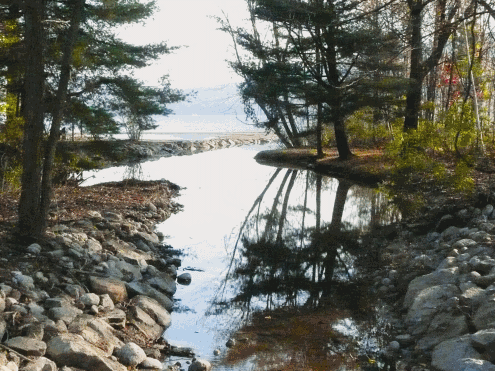 The Lake George Association has constructed a new sediment pond at English Brook. The pond is designed to capture hundreds of tons of sediment before it enters Lake George.
The Lake George Association has completed the construction of a new sediment basin at the mouth of English Brook in the town of Lake George at the southern end of the lake. Construction was completed during the last week of October. The 150-foot long sediment basin was designed by the Warren County Soil and Water Conservation District (WCSWCD) with financial assistance from the LGA. The basin will slow down the flow of water and allow sediment to fall out prior to entering the Lake. Grass pavers were also installed to enable future access to the site so that it can be maintained. The basin will be cleaned out every one to two years, when it reaches about 50-75% capacity. Each time it is cleaned out, roughly 300-400 cubic yards of material will be removed.
After Tropical Storm Irene, English Brook changed its route near its mouth: it started flowing in the same path that it did nearly 50 years ago, prior to the construction of the Northway. The last 300 feet of the brook now flows in a northeasterly direction. After input from the NYS Department of Environmental Conservation (DEC), it was determined that the stream should remain in place and the basin installed where the stream is currently flowing.
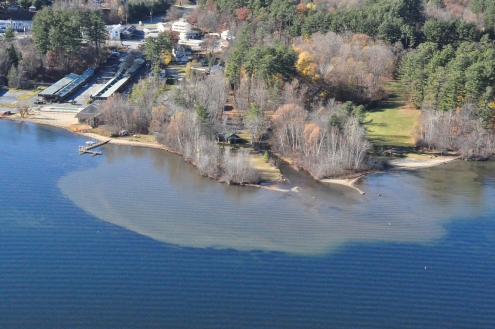
This picture, taken in November 2010, shows the path that English brook took before Tropical Storm Irene and the delta forming in Lake George.
In the aftermath of Tropical Storm Irene, WCSWCD used funds provided by the DEC to pull out trees, remediate the streambank and recreate capacity in the brook. The remainder of these funds will be used to complete more of the projects outlined in a WSCSCD 2008 English Brook Watershed Study, and the LGA will provide supplemental funding for these where possible.
English Brook is one of eight major brooks flowing into Lake George. “LGA lake saving projects make a huge difference to water quality, because stormwater runoff is the number one source of pollutants entering Lake George,” said Randy Rath, LGA project manager.
Since the construction of the Northway, the shoreline near the mouth of English Brook has moved significantly. A cottage that was once right on the lake now sits several hundred yards back. The DEC lists the brook as sediment impaired, and its delta is one of the largest on Lake George. According to National Urban Runoff Program reports conducted during the 1980s, English Brook has high levels of total phosphorus, chlorides, total suspended sediments, lead and nitrate-nitrogen.
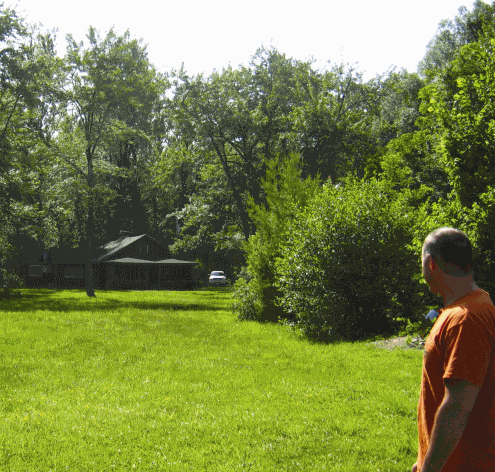
Dave Wick, executive director of the Warren County Soil and Water Conservation District, stands at the current Lake George shoreline near the mouth of English Brook, and looks back at a cottage that was located at the water’s edge some 50 years ago. Construction of the Northway increased the amount of sediment carried downstream and caused the location of the shoreline to change significantly.
English Brook is located just north of Lake George Village at the Lochlea Estate. Earlier this summer, the LGA installed a $49,500 Aqua-Swirl stormwater separator on the property, as part of a $100,000 stormwater project. This system is collecting previously untreated stormwater runoff from both the east and west sides of Rt. 9N, as well as the bridge between the two exits at Exit 22 on Interstate 87. The majority of the runoff in a 48-acre subwatershed is now being captured and treated.
Further upstream, at the Hubble Reservoir, the LGA hired Galusha Construction to remove a non-functioning sluice gate and valve that were making it difficult to maintain the site. The site was dewatered and almost 600 cubic yards of sediment were removed in 2009. This reservoir is slated for cleaning again in 2012. The LGA acquired funding for all of the English Brook projects through grants from the Helen V. Froehlich Foundation and the New York State Department of State and the Environmental Protection Fund, with additional funding for the Aqua-Swirl project provided by the Lake Champlain Basin Program.
Now that much of the needed upland work is complete, the culminating lake saving step for English Brook is to remove the sediment that has built up in the delta in Lake George over the course of generations. The nutrient-rich sediment in deltas supports invasive plant growth, hampers fish spawning, and harbors nuisance waterfowl. By removing the delta, safe navigation is restored, the health of the Lake’s fisheries improves, the Lake returns to its original bottom, and property values are retained.